
Starfish: Much More Than Just a Pretty Beach Souvenir 🌊
Do you know that feeling of walking along the beach and suddenly spotting a bright orange starfish in the shallow water? It's one of those moments that makes you pause for a second. But behind this fascination lies a world full of astonishing facts – and a growing threat that hardly anyone is aware of.
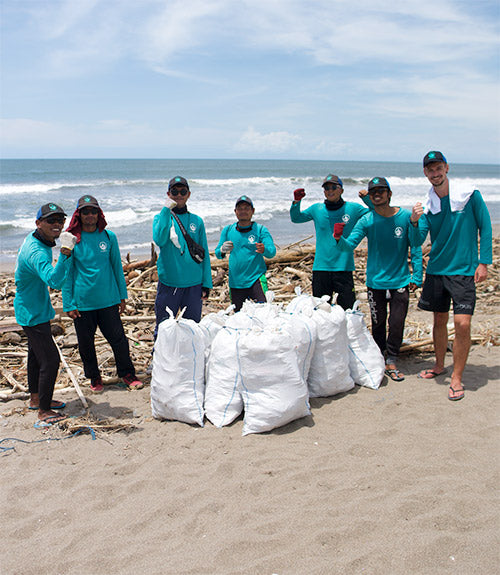
Our 11-person team in Medewi, Bali, regularly finds echinoderms alongside plastic waste in the sand during daily beach cleanups. This prompted Dominik – who quit his job as an engineer at Airbus in 2020 to found Oceanmata – to delve deeper into the world of these fascinating animals.

7 Starfish Facts You Didn't Know
1. Starfish Are Not Fish – And That Makes a Huge Difference
The name is misleading: starfish belong to the class Echinodermata (spiny-skinned animals), related to sea urchins and sea cucumbers. They have no brain, no heart, and no blood in the classical sense. Instead, they pump seawater through their vascular system – an evolutionary masterpiece that has been working for over 450 million years.
2. They Can Lose Arms – And Simply Regrow Them
Starfish possess an extraordinary ability to regenerate. If a starfish loses an arm due to an attack or injury, it simply grows back. In some species, even a single detached arm with a piece of the central body is enough to form an entirely new starfish. Sounds like science fiction – but it's pure biology.
3. They Digest Their Food Outside Their Body
When a starfish eats a mussel, it everts its stomach, pushes it into the tiny gap of the mussel, and digests the animal right on the spot. Only then does it pull its stomach back in. This "external digestion" makes them extremely efficient predators – even mussels that seem impossible for humans to open are no problem for them.
4. Starfish Have Hundreds of Tiny Feet
Under their arms are countless tiny tube feet (ambulacral feet), with which they can cling to rocks, mussels, and sand. These feet work hydraulically – via a water pressure system. This allows them not only to climb but also to pull apart mussels that would pose a challenge to a human.
5. Some Starfish Are Bioluminescent
Some deep-sea starfish species glow in the darkness of the ocean. Their exact function is not yet fully understood: communication, camouflage, or attracting prey? In Medewi, Bali, our team has observed some of these glowing beauties during night dives – an unforgettable experience.
6. Plastic Waste Destroys Their Home in Several Ways
Starfish need clean, oxygen-rich waters. Plastic waste endangers them in several ways: microplastics block the respiratory organs of echinoderms, plastic bags suffocate areas of the seabed, and chemical pollutants from weathered plastic disrupt their hormone systems. In heavily polluted waters, starfish populations are significantly smaller – or have disappeared entirely.

7. There Are Nearly 2,000 Species – And Many Are Threatened
Globally, there are approximately 1,900 known species of starfish, from the deep sea to shallow coral reefs. In recent years, "Sea Star Wasting Disease" has killed millions of specimens on the West Coast of North America alone – and researchers suspect that climate change and rising ocean temperatures are contributing to the disease. A reminder of how fragile these ecosystems are.
What Does All This Have to Do With Your Phone Case?
Granted – the connection may seem far-fetched at first. But it's real: every sustainable phone case from Oceanmata directly funds the collection of 1 kg of plastic from the ocean in Medewi, Bali. Every kilogram collected is one less kilogram that will decompose into microplastics and enter the food chain of starfish, mussels, fish – and us.
When Dominik met a local in Medewi in 2020 who collected plastic alone every day, it left a lasting impression on him. He quit his secure job as an engineer at Airbus and founded Oceanmata. Today, this project has a team of 11 people who clean beach after beach, kilogram after kilogram, every day.
"Beautiful phone case, and the concept is simply great. Finally, a product where you truly know it makes a difference." – Verified Customer, Oceanmata.com ⭐⭐⭐⭐⭐
What You Can Do Today to Protect Starfish
- 🌊 Never remove starfish from the water – even short exposure to air can kill them
- 🛍️ Reduce single-use plastic – plastic bags, straws, and single-use bottles are among the most common beach finds
- 🤿 Support beach cleanups – locally or by purchasing a sustainable product like Ocean-Plastic jewelry from Oceanmata
- 🐢 Adopt an animal – with a marine animal adoption, you actively support the protection of marine ecosystems
- 🔬 Stay informed and share – ignorance is the greatest threat to the oceans
Starfish are not just beautiful photo opportunities for your next vacation in Bali. They are an indicator of the health of our oceans. If they disappear, something fundamental is wrong.
More About the Inhabitants of Our Seas
Fascinated by the underwater world? Check out our other articles: Mantis Shrimp: The Wildest Hunters of the Ocean or Bioluminescence: When the Sea Glows at Night. External source recommendation: the UNEP report on ocean plastic pollution.
🌊 Join Us – For Vibrant Seas with Real Starfish
Every phone case, every adoption, every conscious purchase counts. Our team in Medewi is out there every day – funded by people like you. Together for a plastic-free ocean.