


Credit: @petepontone
Imagine: You arrive in Bali – and the beach is covered in plastic
You've dreamt of this moment for months. Your feet in the sand, the sound of the waves, the view of the Indian Ocean. Then you stand on Kuta, Seminyak, or Medewi beach – and your feet aren't in the sand. They're on plastic. Bottles, bags, packaging, styrofoam, as far as the eye can see 🌊.
What sounds like a dystopia is a bitter reality in Bali every winter. Welcome to monsoon season.
What happens during monsoon season? November to March in a state of emergency
From November to March, the monsoon hits Bali. Heavy rainfall, strong westerly winds, and rough seas transform the island. What many tourists don't know: The monsoon doesn't just bring rain. It brings a plastic flood of biblical proportions.
The numbers are staggering: Bali produces 3,436 tons of waste daily. During the monsoon months, the swollen rivers carry enormous amounts of this waste into the sea – and the westerly winds carry it directly back to the island's west coast. The result: 30 to 60 tons of plastic end up on the beaches every day.
Every day. For five months.
"The plastic was sometimes one meter high on the sand"
The organization Sungai Watch, which works with over 350 river barriers in Bali and has already collected almost 4 million kilograms of waste, documents the escalation during the rainy season anew every year. The images show beaches where plastic waste literally piles up meters high.
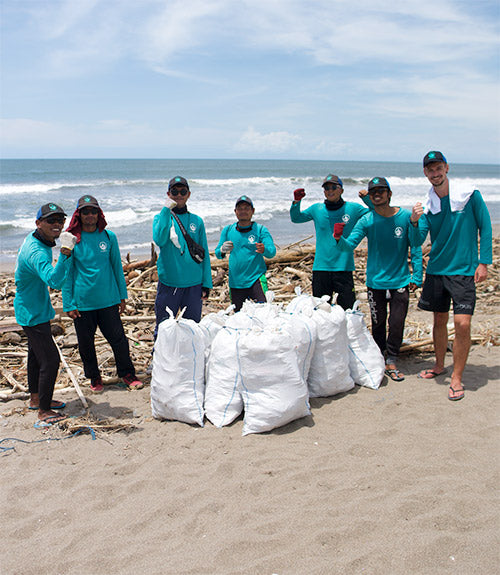
The west coast in particular – from Kuta to Canggu and up to Medewi – is affected. Precisely where our 11-member Oceanmata team works every day. Medewi is one of Bali's plastic hotspots – and also our home.

Credit: @aquanauta_diver
Where does the plastic flood come from?
The cycle is as simple as it is cruel: In Bali and the surrounding islands, there is a lack of functioning waste disposal. Waste is dumped on riverbanks, burned in open pits, or simply left lying around. When the monsoon rains begin, the masses of water wash everything into the rivers. The rivers carry the waste into the sea. And the sea? It spits it back onto the beaches.
It's a vicious cycle – and it repeats itself every year. The beaches, which look like paradise in Instagram photos during the dry season, turn into landfills that smell of decay and chemicals.
That's why at Oceanmata, we distribute free trash cans to locals – because the problem doesn't start at the beach, but where the waste is generated. You can find out the whole truth about plastic in Bali here.
The counter-movement: Hundreds of volunteers, daily clean-ups
But there is hope – and it comes from people who don't look away. Every day, hundreds of volunteers, local NGOs, and organizations go to the beaches to fight the plastic flood. Sungai Watch organizes open clean-ups every Sunday. Trash Hero Bali mobilizes communities. And our own team is on the beach every morning at sunrise.
The counter-movement is growing. More and more locals and tourists are joining. An awareness is emerging that did not exist a few years ago. And that gives courage 💙.
Oceanmata during monsoon season: Our toughest work phase
For our team in Medewi, monsoon season is the most intense time of the year. While other organizations take a break during the rainy season, we really get started. Beach clean-ups in rain and wind. Checking river barriers when the masses of water carry everything away. Recycling with our Precious Plastic machine to transform the collected material into valuable raw materials. School lessons so the next generation can do better.
Since our founding in 2020, we have collected over 300,000 kg of Ocean Plastic. Our core message drives us: Plastic is not waste – it is a valuable raw material. Every kilogram we collect and recycle proves this.
Our community of over 165,000 Ocean Heroes makes this possible. Every Oceanmata bracelet, every sustainable iPhone case, every sponsorship directly funds our work – especially in the months when it is most urgently needed.
What you can do – even from home 🐢
You don't have to be in Bali to make a difference. Monsoon season shows every year how urgently help is needed. And you can be part of the solution – with every decision you make.
🌊 Help us through the toughest months
Monsoon season is our most intense work phase – and we need all the support we can get. With an Oceanmata sponsorship, you ensure that our team can continue working even in storms and rain.
Become a sponsor now →